
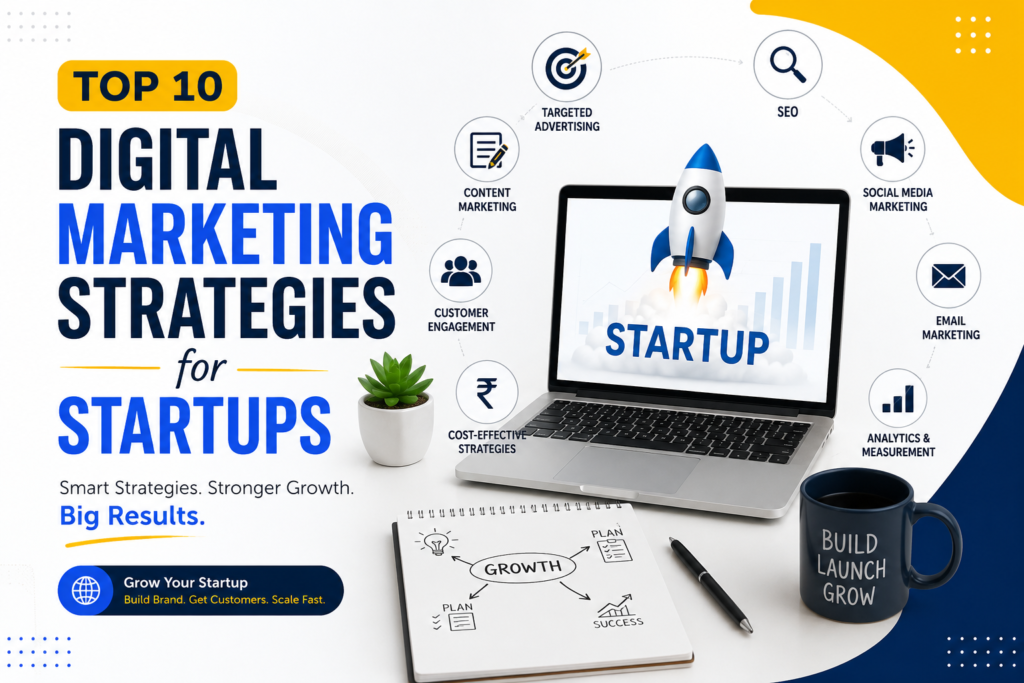
Starting a new business is exciting, but attracting customers and building a strong brand can be challenging. With increasing competition, startups need more than a great product or service—they need a strong digital presence.
Digital marketing for startups provides cost-effective ways to reach potential customers, generate leads, build brand awareness, and increase sales. From SEO and social media marketing to Google Ads and content marketing, the right combination of strategies can help startups grow faster.
In this blog, we will explore the Top 10 Digital Marketing Strategies for Startups and understand how businesses can use them to achieve sustainable growth.
Why Digital Marketing Is Important for Startups
Startups often operate with limited budgets and resources. Traditional marketing can require significant investment, while digital marketing allows businesses to reach specific audiences with measurable campaigns.
A well-planned startup digital marketing strategy can help you:
- Increase brand awareness
- Reach targeted customers
- Generate quality leads
- Improve website traffic
- Build customer relationships
- Increase online sales
- Measure marketing performance
- Compete with established businesses
Let’s explore the top strategies startups should consider.
1. Build a Professional Business Website
Your website is one of the most important digital assets for your startup. It acts as your online identity and gives potential customers information about your products, services, company, and contact details.
A professional website should be:
- Mobile-friendly
- Fast-loading
- Easy to navigate
- SEO-friendly
- Secure
- User-friendly
- Designed with clear calls-to-action
Include important pages such as Home, About Us, Services or Products, Blog, Contact, and Privacy Policy.
Your website should also have clear CTAs such as “Get a Quote,” “Book a Consultation,” “Contact Us,” or “Buy Now.”
A well-designed website can turn visitors into potential customers and support other digital marketing activities.
2. Invest in Search Engine Optimization (SEO)
Search Engine Optimization (SEO) is one of the most effective long-term digital marketing strategies for startups.
SEO helps your website appear in search engine results when potential customers search for products, services, or information related to your business.
Startups can focus on:
- Keyword research
- On-page SEO
- Technical SEO
- Local SEO
- Content optimization
- Internal linking
- Website speed
- Backlink building
For example, a startup providing accounting services in Pune could target keywords such as “accounting services in Pune” or “CA services for startups.”
SEO generally takes time, but consistent optimization and high-quality content can help businesses build sustainable organic visibility.
3. Create a Strong Content Marketing Strategy
Content marketing allows startups to educate their audience while building authority and trust.
Instead of focusing only on promotional content, create useful information that answers your customers’ questions.
Popular content formats include:
- Blog posts
- Guides
- Case studies
- Videos
- Infographics
- Social media posts
- E-books
- Checklists
- FAQs
For example, a digital marketing startup can publish articles about SEO, Google Ads, social media marketing, lead generation, and online advertising.
A strong content marketing strategy can attract organic traffic, support SEO, and help potential customers understand your expertise.
4. Use Social Media Marketing
Social media platforms provide startups with opportunities to connect directly with their target audience.
Depending on your audience and industry, you can use platforms such as Instagram, Facebook, LinkedIn, YouTube, and other relevant channels.
A startup social media strategy can include:
- Educational posts
- Short-form videos
- Customer testimonials
- Product demonstrations
- Behind-the-scenes content
- Industry tips
- Polls and questions
- Promotional campaigns
Consistency is important. Create a content calendar and maintain a regular publishing schedule.
Don’t focus only on follower growth. Track meaningful metrics such as engagement, website visits, inquiries, leads, and conversions.
5. Run Targeted Google Ads Campaigns
SEO is a long-term strategy, while Google Ads can help startups reach potential customers who are actively searching for relevant products or services.
For example, if someone searches for “digital marketing agency near me,” a relevant business can use search advertising to appear in front of that potential customer.
Startups can use different Google Ads campaigns depending on their objectives.
These may include:
- Search campaigns
- Display campaigns
- Video campaigns
- Shopping campaigns
- Performance-oriented campaigns
Before launching a campaign, define your target audience, keywords, budget, landing pages, and conversion goals.
Regularly monitor metrics such as clicks, conversions, cost per lead, and return on advertising spend where applicable.
6. Leverage Meta Ads for Lead Generation
Meta advertising can help startups reach specific audiences across platforms such as Facebook and Instagram.
Meta Ads for startups can be used for:
- Brand awareness
- Website traffic
- Lead generation
- Sales
- App promotion
- Remarketing
Audience targeting can be based on factors such as demographics, interests, behaviors, and interactions, depending on available platform options.
Startups should test different creatives, headlines, offers, and audiences instead of depending on a single advertisement.
For lead-generation campaigns, use a simple form and ask only for information that is genuinely necessary. A complicated form can reduce the number of completed inquiries.
7. Focus on Local SEO
If your startup serves customers in a specific city or geographical area, Local SEO can be extremely valuable.
Local SEO helps businesses improve their visibility for location-based searches.
Start by creating and optimizing your Google Business Profile with accurate information, including:
- Business name
- Address
- Phone number
- Website
- Business category
- Working hours
- Photos
- Products or services
Encourage genuine customers to leave reviews and respond professionally to reviews.
You can also create location-specific website pages and content targeting relevant local keywords.
For example:
“Digital Marketing Services in Pune”
can be more relevant for a Pune-based agency than targeting only the broad keyword “digital marketing services.”
8. Use Email Marketing to Build Relationships
Email marketing remains a useful strategy for nurturing potential and existing customers.
Startups can build an email list through website forms, lead magnets, registrations, purchases, and other legitimate methods.
You can send:
- Welcome emails
- Educational newsletters
- Product updates
- Special offers
- Case studies
- Industry insights
- Event invitations
Email marketing allows startups to communicate directly with people who have already shown interest in their business.
Personalized and useful emails can help nurture leads and encourage repeat purchases.
Always follow applicable privacy, consent, and email marketing regulations when collecting and using customer information.
9. Implement Remarketing Campaigns
Not every website visitor becomes a customer during their first visit.
Remarketing allows businesses to reconnect with people who have previously interacted with their website, advertisements, or other digital assets, subject to platform policies and available consent mechanisms.
For example, a visitor may view a service page but leave without submitting an inquiry. A relevant remarketing campaign may help bring that person back to the business.
Remarketing can be used for:
- Product promotions
- Service inquiries
- Abandoned shopping journeys
- Content promotion
- Lead nurturing
Make sure your campaigns respect user privacy and applicable advertising policies.
10. Track Data and Optimize Marketing Performance
One of the biggest advantages of digital marketing is the ability to measure performance.
Startups should avoid making decisions based only on assumptions. Instead, use data to understand what is working and where improvements are needed.
Important metrics can include:
- Website traffic
- Organic traffic
- Leads generated
- Conversion rate
- Cost per lead
- Click-through rate
- Customer acquisition cost
- Return on advertising spend
- Engagement rate
Analytics tools and advertising platforms can provide valuable performance information.
For example, if one campaign generates significantly more qualified leads than another, you can investigate why and optimize your marketing budget accordingly.
How Startups Can Create a Digital Marketing Plan
Implementing all ten strategies simultaneously may not be practical for every startup.
Instead, create a structured plan.
Step 1: Define Your Target Audience
Identify who your ideal customers are, what problems they face, and what motivates them to purchase.
Step 2: Set Clear Marketing Goals
Your goals could include increasing website traffic, generating leads, increasing sales, or building brand awareness.
Step 3: Select Relevant Channels
Choose marketing channels based on your audience, industry, budget, and objectives.
Step 4: Create Valuable Content
Develop content that answers customer questions and demonstrates your expertise.
Step 5: Launch and Test Campaigns
Start with manageable budgets and test different approaches.
Step 6: Measure Results
Track important KPIs and identify the campaigns and content generating meaningful business outcomes.
Step 7: Optimize Continuously
Digital marketing is not a one-time activity. Regular testing and optimization can improve campaign performance over time.
Common Digital Marketing Mistakes Startups Should Avoid
While developing a startup marketing strategy, avoid these common mistakes:
Ignoring SEO: Building a website without optimizing it for search engines can limit organic visibility.
Targeting everyone: A broad audience can make marketing messages less relevant. Define your ideal customer.
Posting without a strategy: Random social media posts may not support your business objectives.
Ignoring analytics: Without measurement, it becomes difficult to understand marketing performance.
Spending without testing: Start with controlled campaigns and test different variables before increasing budgets.
Focusing only on vanity metrics: Followers and likes can be useful indicators, but leads, sales, conversions, and customer value are often more directly connected to business objectives.
Final Thoughts
A strong digital marketing strategy for startups can help new businesses build visibility, attract potential customers, generate leads, and establish long-term relationships.
The Top 10 digital marketing strategies for startups covered in this article include website development, SEO, content marketing, social media marketing, Google Ads, Meta Ads, Local SEO, email marketing, remarketing, and performance tracking.
Startups don’t necessarily need to use every marketing channel immediately. The right approach is to understand your audience, establish measurable goals, select relevant channels, test campaigns, and continuously optimize based on data.
With a consistent and customer-focused approach, digital marketing can become an important part of your startup’s growth strategy. If you are interested in digital digital marketing strategies, then contact us.